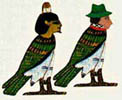
In seven days and nights there was no way I could grasp more than a grain of sand from the vast desert treasure chest that is Egypt. In this absurdly short time my footprints didn't even register on that trampled ground. But I had brought a good pair of eyes, attached to a brain convinced of having intimate prior connections to this place, so I was bound to leave richer than when I arrived.
I knew the colours of Egypt from glossy coffee-table books and museum artefacts but I wasn't prepared for evidence of a unique collaboration between the sun and the land. Maybe because it was happy to be worshipped for so long and so creatively by the ancient Egyptians, the sun liquified and soaked into every crevice of the rocks, every particle of dust, every man-made construction and even into the skin of the people and animals. Egypt is literally sun-coloured.

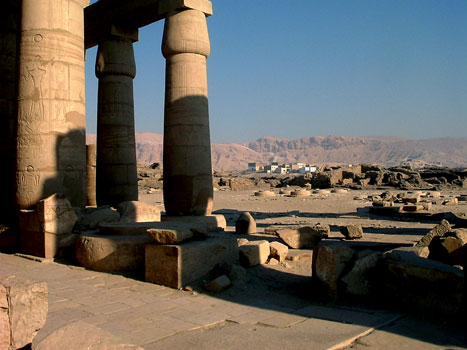
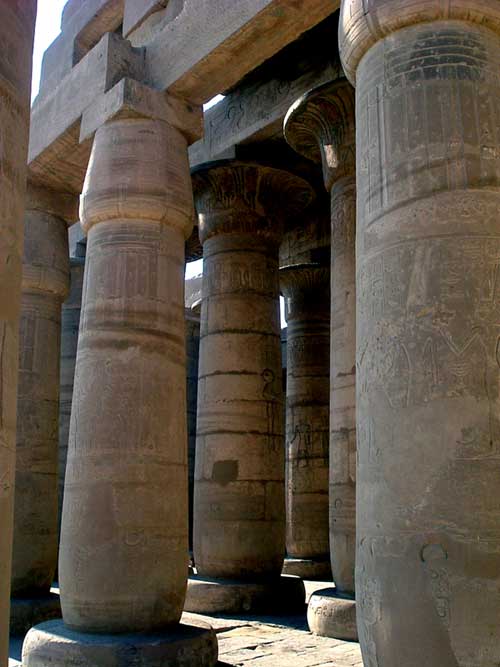
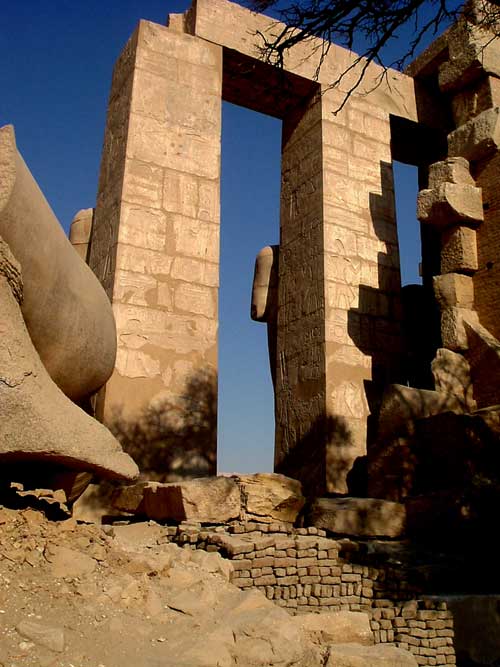
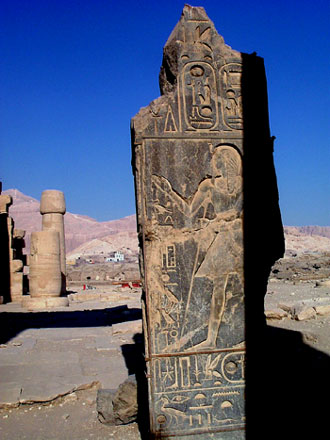
The village above was visible from the Ramesseum, Ramses II's Temple of a Million Years on the West Bank. On the day I was there the temple's melancholy ruins were deserted, apart from a few hopeful Arabs and a bearded foreign expert sitting atop a ladder, devoutly restoring a few inches of incised stone. The place had an extravagantly dismantled air, like an abandoned C.B.De Mille movie set. Once it had employed a million extras, look at it now. Only the sun still lovingly caressing gargantuan columns, swollen with tales of victories retold ad infinitum to the odd academic or the supremely uninterested blue sky.
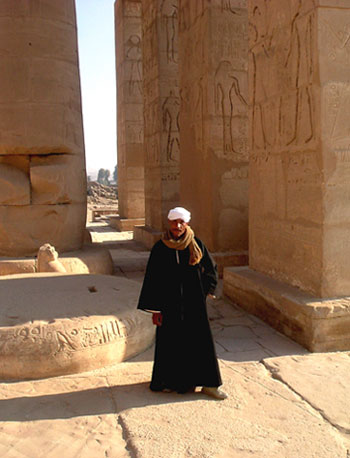
The Arabs, although they too were once foreigners here, perfectly blend into the remnants of Egypt's ancient history. Unlike the necessary hordes of tourists whose voices and clothes and customs are at odds with the surroundings, the dark robed, turbanned figures moving soundlessly between sunstroked pillars become part of the art, a reminder that life once animated it and hands like theirs brought it into being.
 The
Valley of the Queens
is not far from the Ramesseum so that was my next stop by taxi.
I wandered around happily unguided, knowing that the driver would
be waiting for me when I was ready to leave. On the way to and from
my destinations I learned a little more about life in Luxor beyond
the tourist trade. Sayed, my driver, told me about himself, his family,
his job, his dream of marrying a foreign (preferably English) girl.
He was twenty-nine, tall, good-looking, educated, dressed neatly
in non-Arab style and seriously convinced that I could act as go-between
to bring him and a suitable girl together. I told him I didn't know
any suitable, or unsuitable, prospective brides but as I said this,
a thought bubble popped up above my head: "Find him a wife in the blogosphere?" I
have not pursued this bubble but in case there are any sincere young
lady husband-hunters out there, get in touch and I'll send you his
e-mail. I didn't take Sayed's picture and the man in the black djellaba
is not him. He just happened to be hanging around picturesquely in
the Ramesseum.
The
Valley of the Queens
is not far from the Ramesseum so that was my next stop by taxi.
I wandered around happily unguided, knowing that the driver would
be waiting for me when I was ready to leave. On the way to and from
my destinations I learned a little more about life in Luxor beyond
the tourist trade. Sayed, my driver, told me about himself, his family,
his job, his dream of marrying a foreign (preferably English) girl.
He was twenty-nine, tall, good-looking, educated, dressed neatly
in non-Arab style and seriously convinced that I could act as go-between
to bring him and a suitable girl together. I told him I didn't know
any suitable, or unsuitable, prospective brides but as I said this,
a thought bubble popped up above my head: "Find him a wife in the blogosphere?" I
have not pursued this bubble but in case there are any sincere young
lady husband-hunters out there, get in touch and I'll send you his
e-mail. I didn't take Sayed's picture and the man in the black djellaba
is not him. He just happened to be hanging around picturesquely in
the Ramesseum.
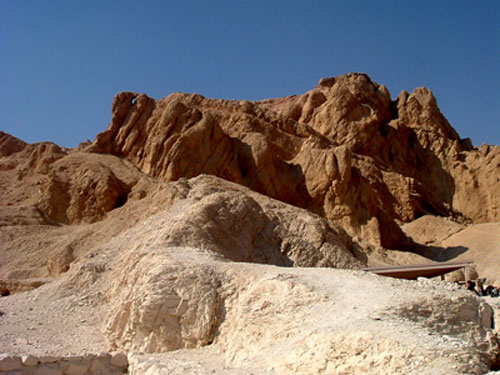
In the Valley of the Queens it was the power of the landscape that impressed me even more than the few tombs I visited. These ochre cliffs, magnificently gnarled pieces of solidified sunlight, will outlast every human attempt to prevent the crumbling of brittle human bones. Most of the tombs here are closed for restoration and I was disappointed to see museum-style glass panels covering stunning wall paintings and bas-reliefs. Of course they need to be protected, but somehow I expected to crawl on hands and knees along narrow torchlit passages. Instead, those tombs that can take tourist traffic are well-lit and fairly well insulated against tourist damage. But the ambiance is claustrophobic, the air stale. An oppressive heaviness blankets you. Death is not uplifting. The lid of a huge ponderous black basalt sarcophagus is open and a delicate mummy rests inside. I'm struck by the absurdity of all this weight, designed to deny the unbearable lightness of being.
Walking around in the small amount of space left between massive pillars, it's impossible not to feel overcome by a sense of seductive subjugation. You are subtly coerced into caressing the rounded carved surfaces, some of the original brilliant colours still remaining. You're free to wander away now that these are only ruins and you are only a tourist. But you can't help thinking that in its heyday, this was not a place you could enter or leave at will.
 The carved figures, hieroglyphs
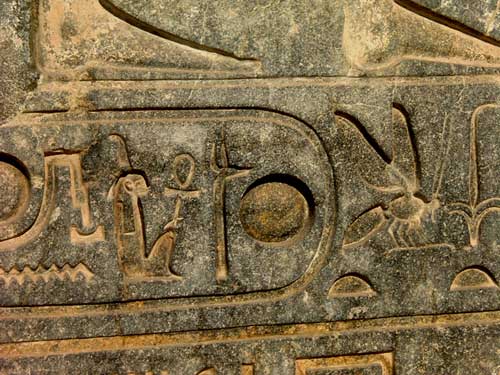
and paintings are luminously beautiful and often at odds with the constructions
which they decorate. It's as though the monarchs dominated the builders and
the builders dominated the artist/artisans.
They were employed as mere hacks ordered to write, on stone, highly edited reports
of their rulers' achievements. But they performed their task with such artistry
and panache that, even though anonymous, their work stands out as the most glorious
of a past rather top-heavy with glory.
The carved figures, hieroglyphs
and paintings are luminously beautiful and often at odds with the constructions
which they decorate. It's as though the monarchs dominated the builders and
the builders dominated the artist/artisans.
They were employed as mere hacks ordered to write, on stone, highly edited reports
of their rulers' achievements. But they performed their task with such artistry
and panache that, even though anonymous, their work stands out as the most glorious
of a past rather top-heavy with glory.
The carved or painted scenes, though always executed according to the prevailing rules, are rich in detail, rhythm, lightness and even humour - a quality definitely absent from the ponderous, po-faced architecture.
I've wondered about Egyptian art - how that style originated, who and what was behind it, how it managed to last for so long and why it is still so hypnotically fascinating. Those always-in-profile figures, the inventive shapes and patterns, the liquid lines and sensuous colours, the geometric harmony of composition, who first thought of it and elaborated it into a visual language? It must have been handed down from one generation to another, flourished for a long time, then began to deteriorate when outside influences diluted and corrupted it.
Nowadays, it's the comic strip artists who are its descendants. I like to think that my ancient Egyptian self is emerging from its shady past, reborn as a bright and shiny cartoon.